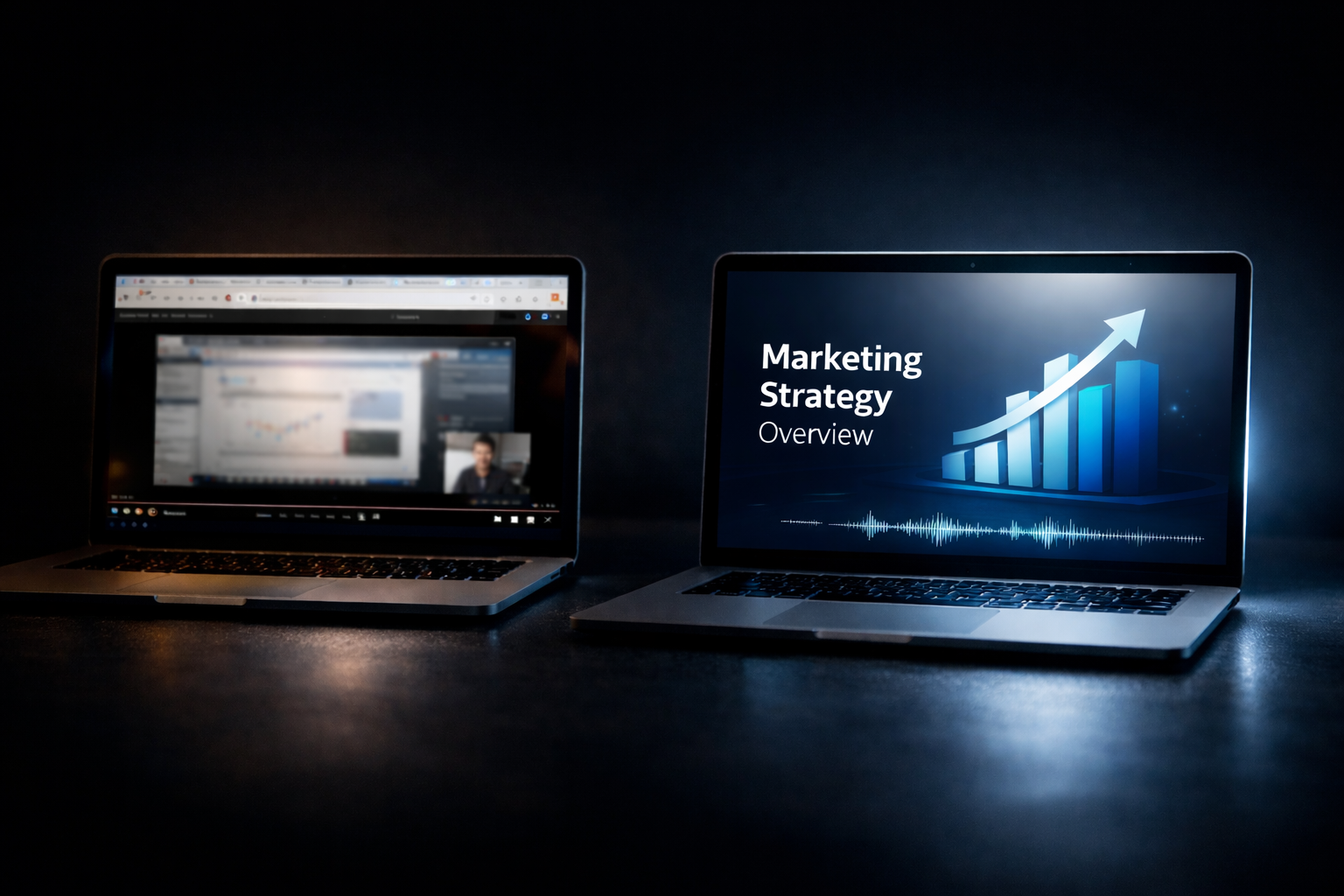
You spend 45 minutes recording a demo Loom. You walk through every screen, cover the workflow, pre-answer the objections. You send the link. And hear nothing.
A week later: “We decided to go in a different direction.”
The product didn’t lose that deal. The recording did.
It’s a pattern I kept noticing — in conversations with founders, in my own experience evaluating SaaS tools, in the way teams talked about their demo process when I asked. That observation is what became LeyCast.
What the prospect actually sees
Here’s what I’ve observed — not as a theory, but from being on both sides of this: in a competitive evaluation, presentation quality becomes a proxy for product quality. Prospects are comparing five vendors at once. They’re time-constrained and pattern-matching constantly. A polished, narrated, branded demo says we take our craft seriously. A raw screen recording with ambient noise and no visual structure says the opposite — even when the underlying product is better than anything else they’re evaluating.
This isn’t superficial. It’s how human beings make decisions under information overload. They use what’s visible as a signal for what isn’t.
The drop-off nobody talks about
Unedited screen recordings have brutal completion rates. Most people open the link. Very few watch more than a minute. The ones who do often skip through the middle. Fewer than half make it to the end.
I’m not citing a study here — this is just what happens when you send people a long, unstructured video with no guiding narrative. The same prospect who would watch a tight 90-second explainer to the end will drop off a 12-minute Loom at the 40-second mark.
The link isn’t failing because the product is bad. It’s failing because raw video is hard to consume. There’s no story arc. There’s no voice pulling the viewer through. It’s a recording, not a communication.
Meanwhile, the competitor your prospect is also evaluating sent them something that looked like it was built for them. Narrated. Branded. Structured. It probably wasn’t — they probably used a tool — but it felt that way. And in a buying decision, how something feels carries real weight.
Why teams don’t fix this on their own
Most sales and marketing teams already know their demo videos could be better. I’ve heard this directly from AEs, SEs, and founders: “I watch my own Looms back and cringe.”
Jargon Lookup: AE and SE
AE (Account Executive) — the salesperson responsible for closing deals with prospects.
SE (Sales Engineer) — the technical counterpart to an AE who runs product demos and handles technical objections.
The problem is the fix looks expensive. A decent freelance video editor charges several hundred dollars per video and needs a week of lead time. Marketing’s production queue is backed up for months. And building the skill in-house — even basic video editing — takes time no one has during an active sales cycle.
So the Loom keeps going out. The rough recording keeps representing a product that deserves better. And the follow-up silence keeps happening.
What makes a demo actually work
I want to be specific here, because “polished video” is vague. Three things actually move the needle:
Structure. A clear opening that names the problem, a middle that demonstrates the solution, and an end that tells the prospect exactly what to do next. Most Looms have none of this — they start with “okay so let me show you…” and meander through screens for ten minutes without a throughline.
Narration. A clean, human-sounding voice that explains what the viewer is seeing and why it matters. Not the recording engineer’s voice over their own keyboard noise, and not a robotic TTS clone — professional AI narration has gotten genuinely good at this.
Jargon Lookup: TTS Text-to-speech — software that synthesises spoken audio from written text. Older TTS sounded obviously robotic; the current generation is good enough that most listeners can’t tell it from a human voiceover in short-form content.
Brand. Logo, colors, fonts. The visual language that reminds the prospect who they’re evaluating. A raw Loom looks like a file. A branded video looks like a product.
When all three are present, the demo stops being a recording and becomes an asset — something you can reuse across every deal with the same profile, embed in your follow-up email, or share on LinkedIn.
How LeyCast works
LeyCast takes a screen recording or a pasted script and produces a finished, branded video automatically.
Upload your recording or paste your text. Select your content type — Demo Explainer, Marketing Video, and others. Choose your brand kit, narrator voice, and music mood. Review the AI-generated storyboard. Approve and download.
No timeline editor. No export settings. What used to take a video team several days takes LeyCast under five minutes.
The output is ready to send to a prospect, embed in a deck, or post on LinkedIn.
The compounding part
A polished demo isn’t just better for one deal. It’s a reusable asset.
Every prospect who asks “can you walk me through how this works?” can receive your best-ever demo — not whatever you happened to record on a Tuesday afternoon when you were tired. You build the definitive version once, polish it once, and use it across every deal in that segment.
Over a quarter, that compounds. Your demo motion tightens. Your follow-up emails have links that get watched. New team members inherit a library of polished assets instead of a folder full of raw files.
That’s what a few minutes of investment per video actually buys you.
Try it
LeyCast is in beta. Joining the founding cohort now locks in pricing below what plans will cost at full launch, plus direct input into how the Demo Explainer workflow develops. If the demo gap sounds familiar, this is the window to get in cheaply.
Join the founding cohort at LeyCast →
Further Reading
- Why Content Teams Are Stuck at One Video a Month — And How to Fix It: The same production gap that stalls sales teams hits content marketing even harder. The underlying problem is identical.
- Why Low-Code Matters for Enterprise Digital Transformation: The broader argument for building tools that remove friction from how teams work — which is what LeyCast is, at its core.
LeyCast is a Codzelerate product. Codzelerate builds software for growing businesses and advises enterprises running Appian — and occasionally the problems we see become products of our own.