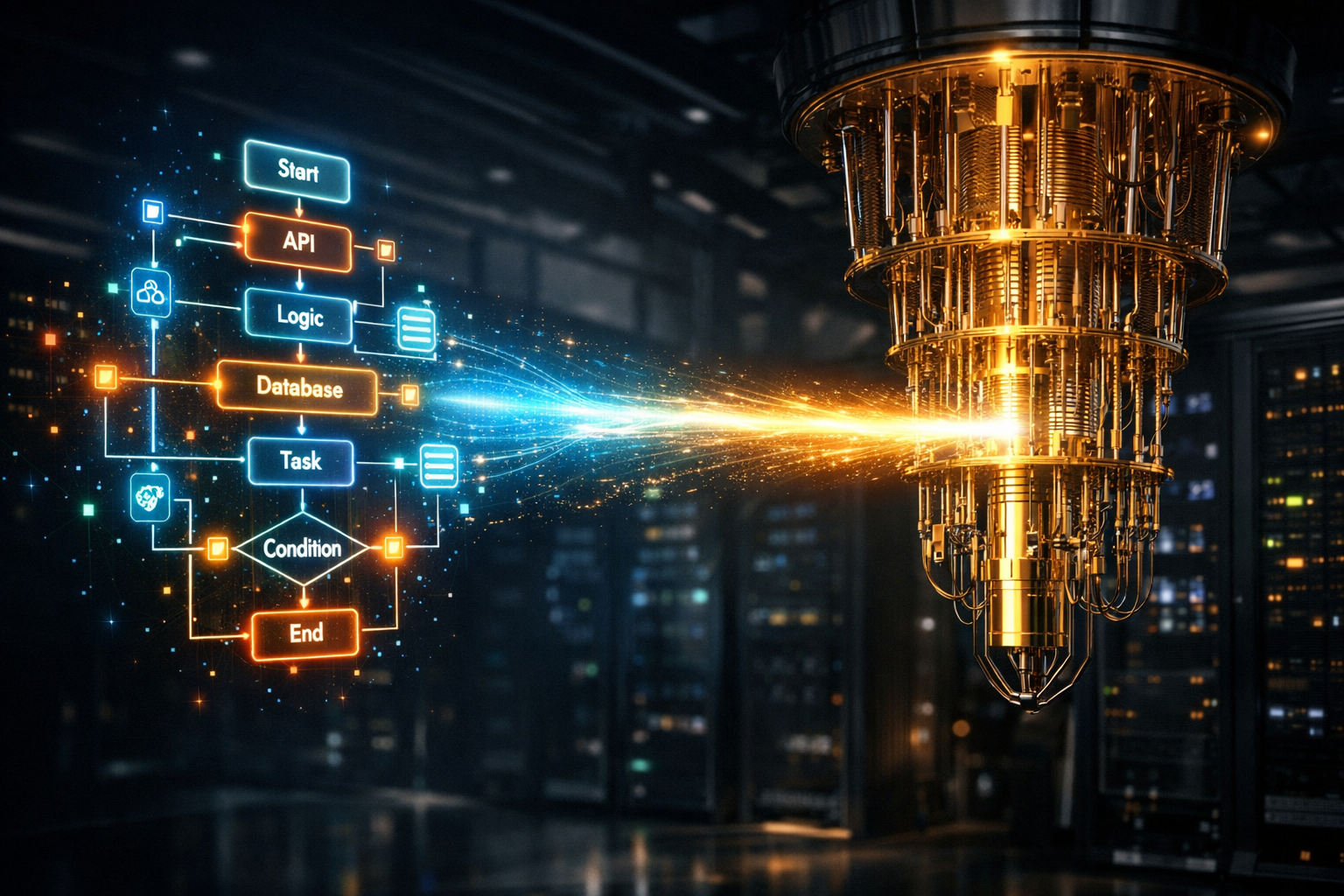
In our previous research on the Hybrid Horizon, we established a fundamental architectural truth: Quantum computers will not replace classical enterprise servers. You’ll never check your email or run a standard SQL query on a quantum machine.
Instead, quantum computers will act as highly specialized, cloud-based co-processors. They will be accessed via APIs strictly to solve specific mathematical bottlenecks that classical servers choke on.
But what does that actually look like in practice? To move past the theoretical hype and attract serious enterprise investment, we must look at how modern classical orchestration layers—like Appian—will integrate with quantum solvers (like D-Wave Leap) to solve real-world problems.
This post walks through an architectural blueprint for one of the most immediate commercial applications of hybrid quantum computing: Dynamic Fleet and Supply Chain Optimization.
The Problem: The “NP-Hard” Logistics Bottleneck
In enterprise logistics, finding the absolute most efficient route for a delivery truck making multiple stops is a variation of the famous “Traveling Salesperson Problem.”
In computer science, this is classified as an NP-Hard problem.
Jargon Lookup: What is NP-Hard? An NP-Hard problem is a mathematical problem where the time it takes to find the perfect solution grows exponentially as you add more variables.
- 5 delivery stops: There are 120 possible route combinations. A standard laptop finds the best one instantly.
- 15 delivery stops: There are over 1.3 trillion possible route combinations.
- 60 delivery stops: There are more possible routes than there are atoms in the observable universe.
A classical supercomputer calculating sequentially would take longer than the age of the universe to evaluate every single option to find the absolute perfect 60-stop route.
Because classical computers cannot solve this exactly in real-time, today’s enterprise logistics software relies on “heuristics”—essentially, highly educated mathematical guesses. It finds a good enough route, but rarely the best available route.
At enterprise scale, the gap between “good enough” and “significantly better” represents millions of dollars in wasted fuel, vehicle wear-and-tear, and missed delivery windows.
The Quantum Advantage: Energy Landscapes
This is where quantum computing steps in. Specifically, a type of quantum technology called a Quantum Annealer is natively designed to solve these exact optimization problems.
Instead of checking route A, then route B, then route C sequentially like a classical server, a quantum computer maps the entire routing problem into a multidimensional energy landscape.
The quantum processor uses the laws of physics to seek the lowest possible energy state in that landscape. That lowest point translates directly to the most mathematically efficient delivery route. By exploiting quantum superposition, it explores a vast solution space and converges on a near-optimal solution in a fraction of the time a brute-force classical approach would require.
The Hybrid Architecture Pipeline
You can’t give a delivery driver a quantum computer. You also can’t build a customer service portal, user authentication, or a relational database on a quantum backend.
This is where the hybrid architecture becomes mandatory. The enterprise low-code platform acts as the “brain” orchestrating the entire workflow.
1. The Classical Frontend (Low-Code Appian)
The low-code platform serves as the system of record.
- The Inputs: Dispatchers use a standard, secure web interface to input new delivery orders, driver schedules, and vehicle constraints.
- The Business Logic: Appian applies standard classical business rules (e.g., Driver A cannot work past 5:00 PM; Truck B requires refrigeration).
- The Payload: An Appian Process Model aggregates this clean, validated data into a structured JSON payload.
2. The API Gateway
The Appian Process Model triggers a secure, asynchronous REST API call to a cloud-based quantum service (such as D-Wave Leap via AWS Marketplace or a dedicated quantum annealing provider).
3. The Quantum Solver
The cloud service acts as a middleware translator. It takes the JSON payload and translates it into a Quadratic Unconstrained Binary Optimization (QUBO) matrix—the specific mathematical language the quantum hardware understands.
- The quantum processor runs its annealing cycle across multiple samples.
- Within seconds, it returns a near-optimal solution array back to the API gateway.
4. The Orchestration Return
The Appian process model catches the returning API response. It parses the optimized quantum route, updates the underlying relational database (e.g., PostgreSQL), and dispatches the turn-by-turn directions to the drivers’ classical mobile apps.
Architecting for Failure: The Classical Fallback
Any senior architect will look at this pipeline and ask: “What happens if the Quantum API times out or the quantum hardware is down?”
A resilient enterprise system cannot halt global logistics because a specialized co-processor is offline. Your low-code orchestration layer must include an automated fallback loop.
If the Appian REST integration to the quantum solver times out after 3 seconds, the process model should automatically route the data payload to a secondary, classical heuristic engine (like a standard Python routing script or Google Maps API).
The business still gets a serviceable route, the trucks keep moving, and the enterprise experiences zero downtime.
Why Low-Code is the Missing Link
Quantum algorithms are highly fragile and mathematically dense. The teams building these algorithms (quantum physicists and advanced data scientists) do not want to spend their time building user authentication screens, mobile apps, database schemas, and API error-handling loops.
By positioning an enterprise low-code platform as the orchestration layer, businesses can wrap complex quantum processing in a secure, scalable, and user-friendly classical wrapper.
The future of enterprise architecture isn’t fully classical, and it isn’t fully quantum. It’s the seamless orchestration of both.
Getting Started
The theoretical phase of quantum computing is giving way to early practical experimentation. While a definitive quantum advantage for logistics has yet to be proven at scale, the architectural patterns for hybrid integration are maturing now. Let’s discuss how your current tech stack can act as the springboard for hybrid quantum optimization.
Subscribe Now to follow our ongoing research on the hybrid horizon, or reach out to Contact us to discuss your long-term architectural strategy.
Further Reading
- The Hybrid Horizon: Orchestrating Quantum Computing with Low-Code: Read our foundational thesis on why low-code platforms are uniquely positioned to become the classical orchestration engines for future quantum APIs.
- The Blueprint for Continuous Delivery in Appian: Before you can integrate next-generation APIs, your classical house must be in order. Learn our framework for zero-downtime deployments and automated quality gates.