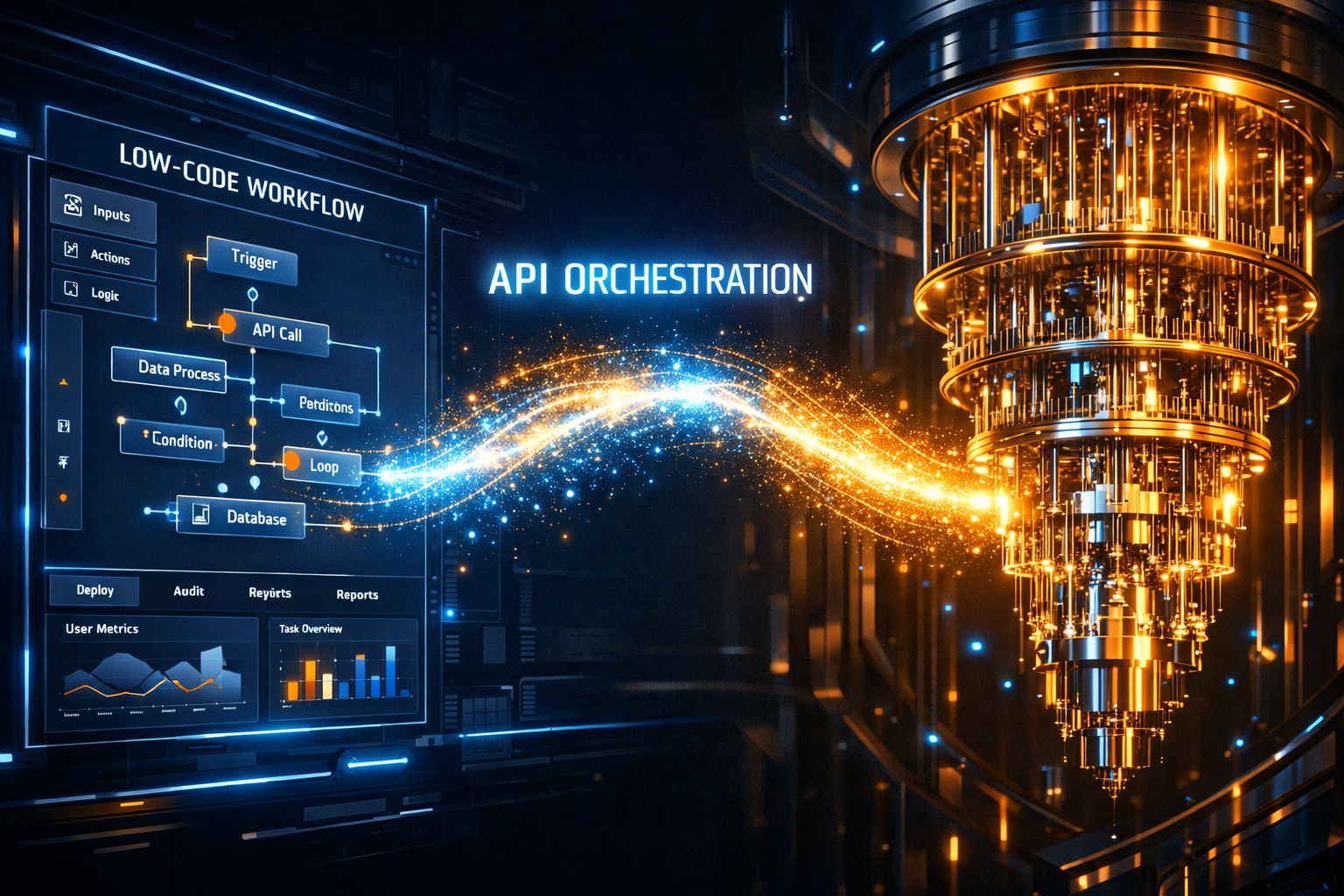
The breakthroughs happening in quantum physics right now are staggering. Researchers and hardware engineers are doing the monumental work of stabilizing qubits, reducing error rates, and pushing the boundaries of computation.
But as these machines mature and become available via cloud services, a parallel challenge emerges for the Enterprise Architect: how will we actually integrate these specialized processors into our daily business operations?
There’s a common misconception that quantum computers might one day sit on our desks or completely replace our classical cloud servers. However, quantum computers are highly specialized tools. They aren’t designed to render user interfaces, query standard SQL databases, or run basic web applications. They are built to solve incredibly complex, multidimensional probability problems.
Because of this, the most likely path forward is that enterprises will interact with quantum processors exactly how they interact with other complex external systems today: through APIs.
Let’s look at the emerging hybrid architecture, and why classical low-code platforms might just become the frontend of the quantum integration layer.
The Anticipated Hybrid Architecture
It’s highly unlikely that enterprise developers will be writing standard business applications in quantum programming languages like Q# or raw Qiskit. Instead, industry leaders anticipate that enterprise software will adopt a hybrid quantum-classical model.
In this model, classical servers (your Next.js frontends, your Appian or OutSystems workflows) will continue to handle business rules, user experience, and state management. When the classical system encounters a highly complex optimization problem—like supply chain routing, financial risk modeling, or molecular simulation—it will package that data and fire it off to a cloud-based Quantum Processing Unit (QPU) via services like AWS Braket or IBM Quantum.
The QPU processes the probabilities, finds the optimal answer, and sends the payload back. The classical system then takes over to render the result for the human user.
Why Low-Code is the Perfect Quantum Orchestrator
If the quantum computer is the high-performance engine, the classical application is the steering wheel. Platforms like Appian and OutSystems are uniquely positioned to build these steering wheels for three practical reasons:
1. Abstraction of Complexity Quantum SDKs are highly technical and Python-heavy. Enterprise IT teams don’t need 50 quantum physicists on staff. Instead, a core backend team can wrap a Python quantum script into a microservice (e.g., an AWS Lambda function) and expose it as a REST API. An Appian or OutSystems developer can then simply consume that endpoint, dragging and dropping a “Quantum Route Optimizer” smart service into their visual process model.
2. Data Translation and Pre-Processing Quantum computers don’t understand messy CRM data or relational SQL tables. They require highly specific mathematical arrays (like Hamiltonians). Low-code excels at the integration layer—querying multiple classical databases, cleaning the data, and formatting it into a strict JSON payload before sending it to the quantum cloud.
3. State Management and “Human-in-the-Loop” Accessing real QPUs via the cloud is an asynchronous process. Your job is placed in a queue, and it takes time to run. Low-code platforms are masterclasses in long-lived state management. An Appian process can trigger the hybrid quantum job, safely suspend the workflow while waiting for a webhook callback, and then route the final optimized result to a human manager for approval (Human-in-the-Loop).
A Practical Real-World Scenario: Supply Chain Optimization
To ground this in reality, imagine a global logistics company using a custom classical application to manage its cargo ships.
A massive storm hits the Pacific, disrupting hundreds of shipping routes. For classical computers to recalculate the single most fuel-efficient set of new routes (a variation of the Traveling Salesman problem on a massive scale), it can be computationally exhausting and time-consuming.
In a hybrid architecture:
- The dispatcher clicks “Recalculate Routes” in their low-code dashboard.
- The low-code workflow queries the legacy ERP for ship coordinates and weather constraints, formatting them into a JSON array.
- The system sends this array to a serverless function, which triggers an AWS Braket hybrid job.
- The quantum computer evaluates vast combinations of routes simultaneously.
- Once calculated, a webhook fires back to the low-code platform, updating the classical database.
- The dispatcher’s screen refreshes with the new map.
The dispatcher doesn’t need to know how superposition works. They just experience a system that solves complex problems with unprecedented efficiency.
The Collaborative Horizon
Building the quantum future requires a massive, cross-disciplinary effort. We rely on brilliant physicists and material scientists to build the hardware, and we will need classical software architects to build the bridges.
The organizations that thrive in the coming decades won’t just be the ones building the QPUs; they will also be the enterprises that figure out how to seamlessly orchestrate their classical workflows around these powerful new quantum APIs.
Deep tech is approaching. As architects, our job is to ensure our integration layers are ready to connect to it.
Stay Ahead of the Curve
We are actively exploring the intersection of enterprise architecture, low-code orchestration, and emerging deep tech. Subscribe to the Codzelerate Newsletter to get our latest research and architectural deep-dives delivered straight to your inbox.
Further Reading
If you want to explore the technical intersection of classical APIs and quantum processing, here are a few excellent resources to continue your research:
- Quantum Computing Isn’t Standalone: Orchestrating Hybrid Quantum Workflows – Medium (Yee Tong): A fantastic breakdown of using AWS and Kubernetes as the orchestration layer for quantum tasks.
- DevOps for Quantum Computing: Architecting a Deployment Framework – HackerNoon: An exploration of how to deploy hybrid Qiskit applications and manage serverless orchestration.
- Introduction to Qiskit Runtime Execution Modes – IBM Quantum Documentation: Official documentation on how IBM handles hybrid classical-quantum workloads via APIs.
- Getting Started with Amazon Braket Hybrid Jobs – PennyLane Demos: A technical look at how AWS Braket spins up classical compute to run algorithms alongside quantum resources.
P.S. Still focused on mastering your current classical stack? Read our latest deep-dive on Forensic Debugging in Appian.