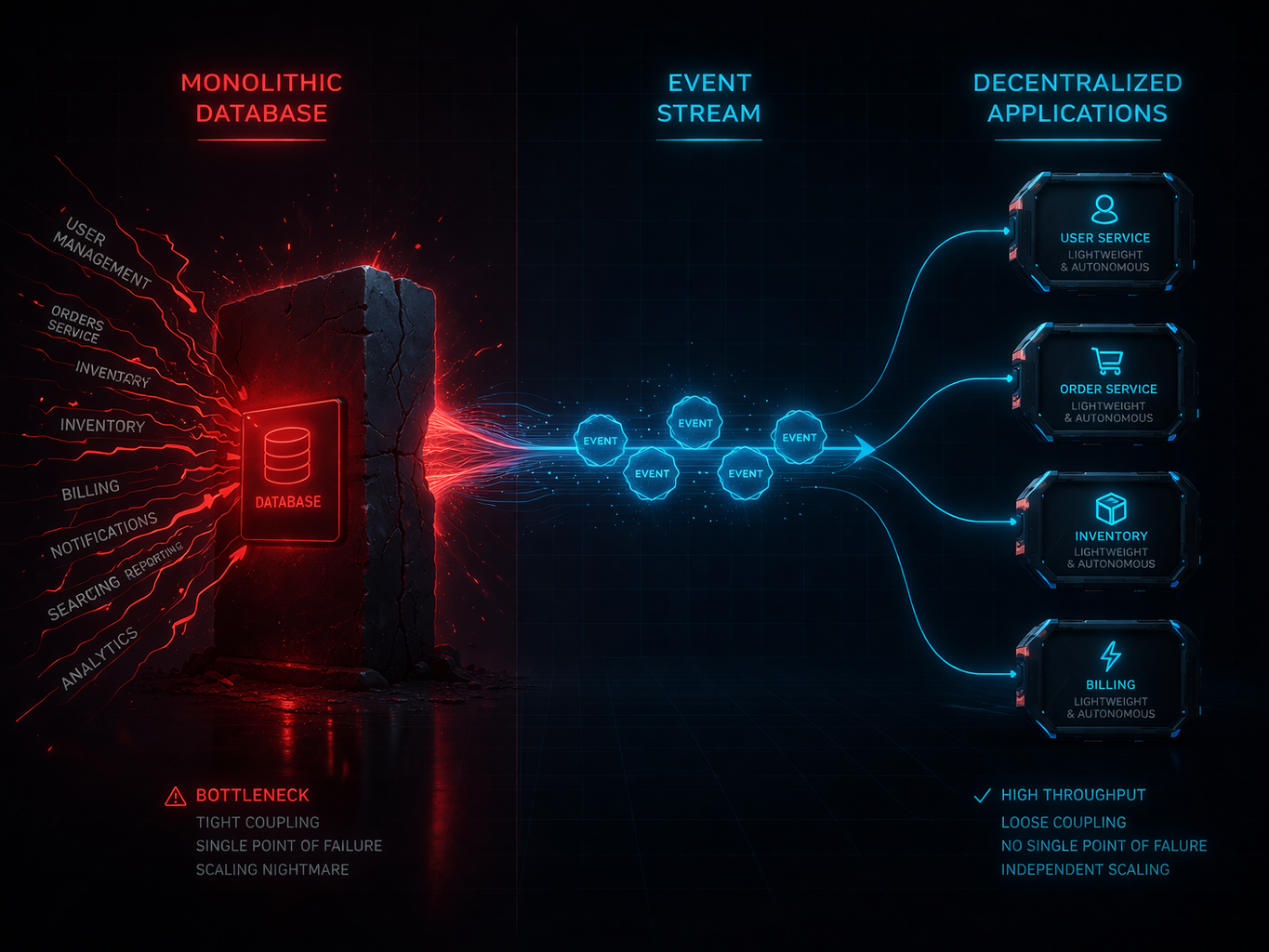
Low-code platforms like Appian are famous for their speed to market. But that same speed often leads development teams straight into a massive architectural trap: the Low-Code Monolith.
Because it’s so incredibly easy to connect interfaces, process models, and records in a low-code environment, teams naturally build massive, tightly coupled applications. Everything is wired to everything else. Over time, these monoliths become brittle—changing a single data type in the HR module accidentally breaks the Finance dashboard.
But worse than the brittle code are the terrible performance habits monoliths breed. To scale a platform across an enterprise without degrading performance, architects must break the monolith and transition to an Event-Driven Architecture (EDA).
The Anti-Pattern: The Database Polling Trap
When disparate systems need to talk to each other, developers often rely on an integration anti-pattern known as “Polling.”
Imagine an Appian application that needs to know when an invoice is marked “Paid” in an external ERP system (like SAP) so it can trigger an onboarding task. The standard, flawed approach is to build an Appian Process Model with a Timer Event. Every 5 minutes, 24 hours a day, Appian runs a process that queries the ERP database: “Are there any new paid invoices?”
Jargon Lookup: Database Polling Polling is the software equivalent of a kid in the backseat on a road trip constantly asking, “Are we there yet?” More than 99% of the time, the answer is no. But the driver still has to expend the energy to answer.
If you have 50 different processes polling your database every few minutes, you are flooding your infrastructure with useless queries. You create database deadlocks, exhaust your connection pools, and drag the entire platform’s performance to a crawl.
The Architect’s Solution: Event-Driven Design
In an Event-Driven Architecture, components don’t ask for information; they wait to be told. The system reacts to state changes (events) the absolute millisecond they happen.
In software engineering, this is often called the Hollywood Principle: “Don’t call us, we’ll call you.”
Instead of Appian constantly asking the ERP if an invoice is paid, the ERP tells Appian the moment the payment clears. Let’s walk through how to actually build this in an enterprise environment.
1. The Webhook Trigger
Instead of a timer, the Appian Architect exposes a secure, dedicated Appian WebAPI endpoint (e.g., /api/v1/invoice-events).
When the ERP system registers a payment, it fires a lightweight JSON “Webhook” to that Appian API. A Webhook is simply an automated message sent from one app to another when something happens. Appian catches this payload and instantly launches the onboarding process model.
- The Result: Zero wasted database queries. Real-time execution. A massive reduction in server overhead.
2. Decoupling with Message Brokers (Kafka / RabbitMQ)
Webhooks are great, but as your enterprise scales, point-to-point API integrations become risky.
What happens if the Appian server is undergoing a 5-minute Sunday maintenance window exactly when the ERP sends the Webhook? The connection fails, the payload drops, and that “Invoice Paid” event is lost forever in the digital void.
For mission-critical architecture, you must introduce a Message Broker between your systems.
Jargon Lookup: Message Broker Think of a message broker (like Apache Kafka or RabbitMQ) as a highly secure digital post office. Instead of the ERP trying to hand the message directly to Appian, the ERP drops the message off at the Kafka Post Office. Kafka puts it in Appian’s dedicated P.O. Box. Appian then checks its box and processes the mail whenever it is ready.
- The ERP publishes the “Invoice Paid” event to a Kafka topic.
- Appian acts as a “subscriber” to that topic.
- If Appian goes offline, Kafka holds the message securely. The moment Appian reconnects, it pulls the backlog of events and resumes processing seamlessly.
This completely decouples the sender from the receiver, ensuring absolute data resilience and zero data loss.
3. The “Fire and Forget” UI Pattern
Event-driven design isn’t just for system-to-system integration; it dramatically improves the end-user experience.
If a user clicks “Generate 500-Page PDF Report” on an Appian SAIL interface, don’t make the interface wait synchronously for the process to finish. If you do, the user will be staring at a frozen loading spinner for three minutes until their browser session times out.
Instead, use a Fire and Forget pattern.
- The UI button triggers an asynchronous process model in the background.
- The interface instantly returns a success message to the user: “Report generation started. You’ll receive an email when it’s ready.”
- The heavy processing happens entirely out of sight, freeing up the user to continue their work immediately.
Breaking the Monolith
Transitioning to an event-driven architecture forces you to decouple your low-code applications.
Instead of one massive, tangled system sharing a single database schema, you build smaller, domain-specific application modules that communicate with each other strictly through APIs and events.
By eliminating database polling and embracing asynchronous event streams, you future-proof your low-code platform to handle true enterprise scale—without the monolithic lag.
Getting Started
If your Appian environment is drowning in timer-based polling jobs and tangled process models, it might be time to rethink the architecture. We write about these patterns regularly.
Subscribe Now to follow our ongoing research on enterprise architecture, or reach out to Contact us to discuss your platform’s performance strategy.
Further Reading
A high-performance architecture requires a clean operational baseline. Ensure your platform is optimized and your deployments are secure with our previous guides:
- The Architect’s Blueprint: A Comprehensive Strategy for Appian Health Checks: Learn how to identify performance killers like database polling before they bring your system down.
- Zero-Downtime Deployments in Appian: An Architect’s Guide to CI/CD: Once you decouple your monolith, learn how to deploy those independent modules seamlessly without taking the business offline.
- Applied Quantum Orchestration: Solving NP-Hard Logistics in Real-Time: See how event-driven, API-first architecture in Appian acts as the exact foundation needed to orchestrate next-generation quantum computing solvers.